
Selecting a premium cigar is an exercise in physics as much as it is an indulgence of the senses. While many enthusiasts choose a cigar based on the time they have available—a quick 30-minute Robusto or a two-hour Churchill—the physical dimensions of the stick dictate the very chemistry of the smoke. If you have ever wondered why the exact same tobacco blend tastes vastly different in a slim Panatela versus a chunky Gordo, the answer lies in the intricate relationship of cigar ring gauge vs flavor.
In this definitive guide, we will explore how the “architecture” of a cigar—its diameter, shape, and internal density—defines the intensity, temperature, and complexity of your smoking experience.
1. The Technical Foundation: What is a Ring Gauge?
To understand the impact of cigar ring gauge vs flavor, we must first define the industry-standard unit of measurement. In the world of premium cigars, diameter is measured in “rings.” A single ring is equivalent to $1/64$ of an inch.
-
A 32-ring gauge cigar is $32/64$, or exactly 1/2 inch thick.
-
A 48-ring gauge cigar is $48/64$, or exactly 3/4 of an inch thick.
-
A 64-ring gauge cigar is $64/64$, or exactly 1 inch thick.
Historically, cigars were much thinner than they are today. In the mid-20th century, a 42-ring gauge “Corona” was considered the gold standard. However, modern preferences have shifted toward “heavy” gauges, with 54, 56, and even 60-ring cigars becoming commonplace. This shift isn’t just a matter of fashion; it fundamentally changes how the tobacco leaves interact during combustion.
2. The Golden Ratio: Wrapper vs. Filler
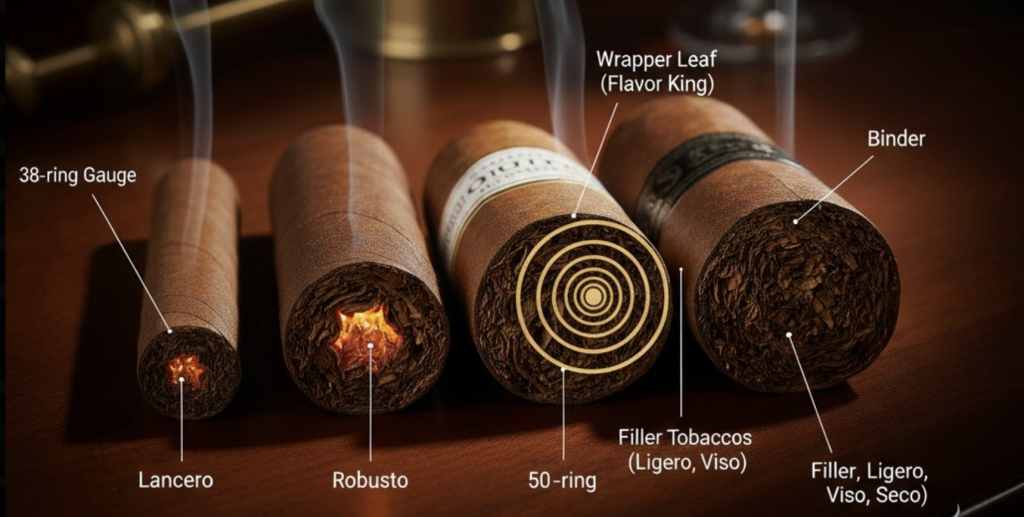
The most significant scientific factor in the cigar ring gauge vs flavor debate is the “Wrapper-to-Filler Ratio.”
A premium cigar consists of three parts: the filler (the heart), the binder (the structural leaf), and the wrapper (the outer skin). The wrapper leaf is the most expensive, highest-quality, and most flavorful tobacco in the entire assembly. Depending on the size of the cigar, the wrapper can contribute anywhere from 60% to 90% of the total flavor profile.
The Intensity of Small Gauges (38–44)
In a thinner cigar, such as a Lancero or Petit Corona, there is a very small volume of filler tobacco. Consequently, the wrapper leaf is the “star of the show.” When you smoke a thin ring gauge, you are tasting the purest expression of that outer leaf. If it is a spicy Habano or a fermented Maduro, those notes will hit your palate with laser-like focus.
The Complexity of Large Gauges (52–60+)
As the diameter increases, the volume of filler tobacco grows exponentially. In a 60-ring gauge cigar, the wrapper becomes a much smaller percentage of the total “smoke recipe.” This allows the master blender to include a “symphony” of different filler leaves—perhaps combining ligero for strength, seco for aroma, and viso for burn rate. The result is a more complex, multi-layered profile where the wrapper provides a subtle frame rather than the main picture.
3. How Tapered Shapes Impact Cigar Ring Gauge vs Flavor
The silhouette of a cigar—its “vitola”—is the second pillar of taste. Cigars generally fall into two categories: Parejos (straight-sided) and Figurados (tapered).
Parejos: The Consistent Burn
Most cigars, like the classic Robusto or Toro, are Parejos. Because the diameter is uniform from the foot (the lit end) to the head (the end you cut), the airflow remains consistent. The flavor typically builds in strength linearly as the oils and tars naturally accumulate toward the head.
Figurados: The Focused Palate
Shapes like the Belicoso, Torpedo, and Piramide feature a tapered head. This design serves a specific functional purpose regarding cigar ring gauge vs flavor:
-
Concentrated Smoke: By tapering the head, the smoke is forced through a smaller aperture. This increases the velocity of the smoke as it hits your tongue, intensifying the flavors of the oils.
-
The Perfecto Evolution: A Perfecto is tapered at both ends. It starts with a sharp burst of wrapper flavor at the “nipple” foot, opens up into a full-bodied filler experience in the wide “bulb,” and narrows again at the finish for a powerful, concentrated finale.
4. The Physics of Combustion: Heat and Oxygen
One of the most overlooked elements of the cigar ring gauge vs flavor dynamic is the temperature of the burn. Combustion is a chemical reaction that requires oxygen. The volume of air moving through the cigar determines how hot the “cherry” burns.
The “Hot” Smoke of Thin Cigars
Thin cigars have a tighter draw and less surface area. This means the lit end (the cherry) stays very close to the center of the tobacco. If you puff a thin cigar too quickly, the temperature skyrockets, which can scorch the delicate oils and make the cigar taste bitter or “charred.” However, when smoked slowly and with discipline, the higher heat can unlock bright, floral, and spicy notes that a cooler smoke cannot reach.
The “Cool” Smoke of Thick Cigars
Large ring gauges allow for more airflow, which naturally cools the smoke before it reaches your mouth. This is ideal for tasting deep, earthy, and chocolatey notes—flavors often found in Maduro or heavy Nicaraguan fillers. A cooler burn prevents the “burnt” taste and preserves the creamy texture that many modern smokers crave.
5. The Evolution of the Draw: Resistance and Airflow
For many enthusiasts, the “draw”—the ease with which you can pull smoke through the cigar—is the most important part of the experience. This is another area where cigar ring gauge vs flavor becomes vital.
-
Tight Draw (Small Gauge): Offers more resistance. This requires the smoker to take smaller, more deliberate puffs, which can lead to a more meditative and nuanced tasting session.
-
Loose Draw (Large Gauge): Often referred to as “smoking a chimney.” It provides massive clouds of smoke with very little effort. While satisfying, a draw that is too loose can lead to a hollow flavor profile because the smoke is over-diluted with oxygen.
6. Historical Context: Why Are Cigars Getting Thicker?
To truly master the concept of cigar ring gauge vs flavor, it helps to look at where we started. In the “Golden Era” of Cuban cigars, the Lancero (38 x 7 ½) was considered the pinnacle of elegance. It was the preferred size of world leaders and connoisseurs.
However, the “Big Ring Revolution” began in the late 1990s and peaked in the 2010s. Why the change?
-
Consistency: Thicker cigars are easier to roll consistently. A minor “bunching” error in a thin Lancero will plug the cigar entirely, whereas a 60-ring gauge is much more forgiving.
-
Mellowness: As tobacco blends became stronger and more “Ligero-heavy,” smokers looked for larger diameters to cool down the intensity of the nicotine.
-
Value: Psychologically, many consumers feel they are getting more “tobacco for their buck” with a larger format, even if the flavor is less concentrated.
7. Matching the Size to the Blend: The OMG Cigars Philosophy
At OMG Cigars, Dave Farmer approaches blending with a “Format-First” mentality. We recognize that our Connecticut line, featuring the delicate Nicaraguan Lahara leaf, requires a specific ring gauge to shine.
If we were to put that creamy Connecticut wrapper on a 70-ring gauge cigar, the flavor of the wrapper would be completely lost against the mountain of filler tobacco. Conversely, putting a heavy, spicy Habano blend into a tiny Cigarillo might be overwhelmingly harsh for most palates.
We curate our vitolas to ensure that the cigar ring gauge vs flavor balance is mathematically perfect. When you smoke an OMG Cigar, you are experiencing the blend exactly as the master blender intended—where the wrapper and filler work in harmony, not in competition.
8. Practical Tips: How to Choose Your Next Smoke
If you are standing in a humidor trying to decide based on cigar ring gauge vs flavor, ask yourself these three questions:
-
How much time do I have? (Thick = Long / Thin = Variable)
-
Do I want to taste the wrapper or the blend? (Thin = Wrapper / Thick = Blend)
-
What is the weather? (Hot days usually call for cooler-burning, larger ring gauges; cold nights are great for the quick, intense heat of a smaller gauge.)
| Vitola Name | Typical Dimensions | Flavor Character | Time Investment |
| Petit Corona | 42 x 5″ | Sharp, focused, wrapper-heavy | 30–40 Mins |
| Robusto | 50 x 5″ | Balanced, rich, classic | 45–60 Mins |
| Toro | 52 x 6″ | Complex, evolving, smooth | 60–90 Mins |
| Churchill | 48 x 7″ | Elegant, steady, traditional | 90+ Mins |
| Gordo | 60 x 6″ | Mellow, cool, high-volume | 2 Hours |
9. Conclusion: The Subjectivity of the Smoke
Ultimately, the debate of cigar ring gauge vs flavor ends with your personal palate. There is no “correct” size, only the size that delivers the experience you desire at that moment.
By understanding the physics of the burn—the wrapper-to-filler ratio, the temperature of the cherry, and the concentration of the draw—you can move beyond simply “smoking” and begin “analyzing” your cigars. The next time you visit “The OMG Humidor,” try picking up two different sizes of the same blend. The transformation in flavor will tell you everything you need to know about the art of the ring gauge.